Valuation • Financial Turnaround • Fraud Investigations • Advisory Services
Buying and Selling Automobile Dealerships
IF IT’S NOT WRITTEN, IT’S NOT IN THE WORLD
WHAT WE DO
We are advisors, not brokers.
We provide the judgment acquired from decades of buying, selling, valuing, restructuring, and advising automobile dealerships. Experience cannot eliminate every risk, but it can identify costly mistakes before they happen.
When I began representing dealers in 1972, many buy-sell agreements were literally written on paper napkins, placemats, or across a table in a coffee shop.
There were no personal computers, no internet, and no books for dealers on the subjects and very little guidance for attorneys representing car dealers.
To bring order to the process, I spent nearly ten years researching, organizing, and writing a comprehensive two-volume reference on buying, selling, and representing automobile dealerships, dealer principals and investors.
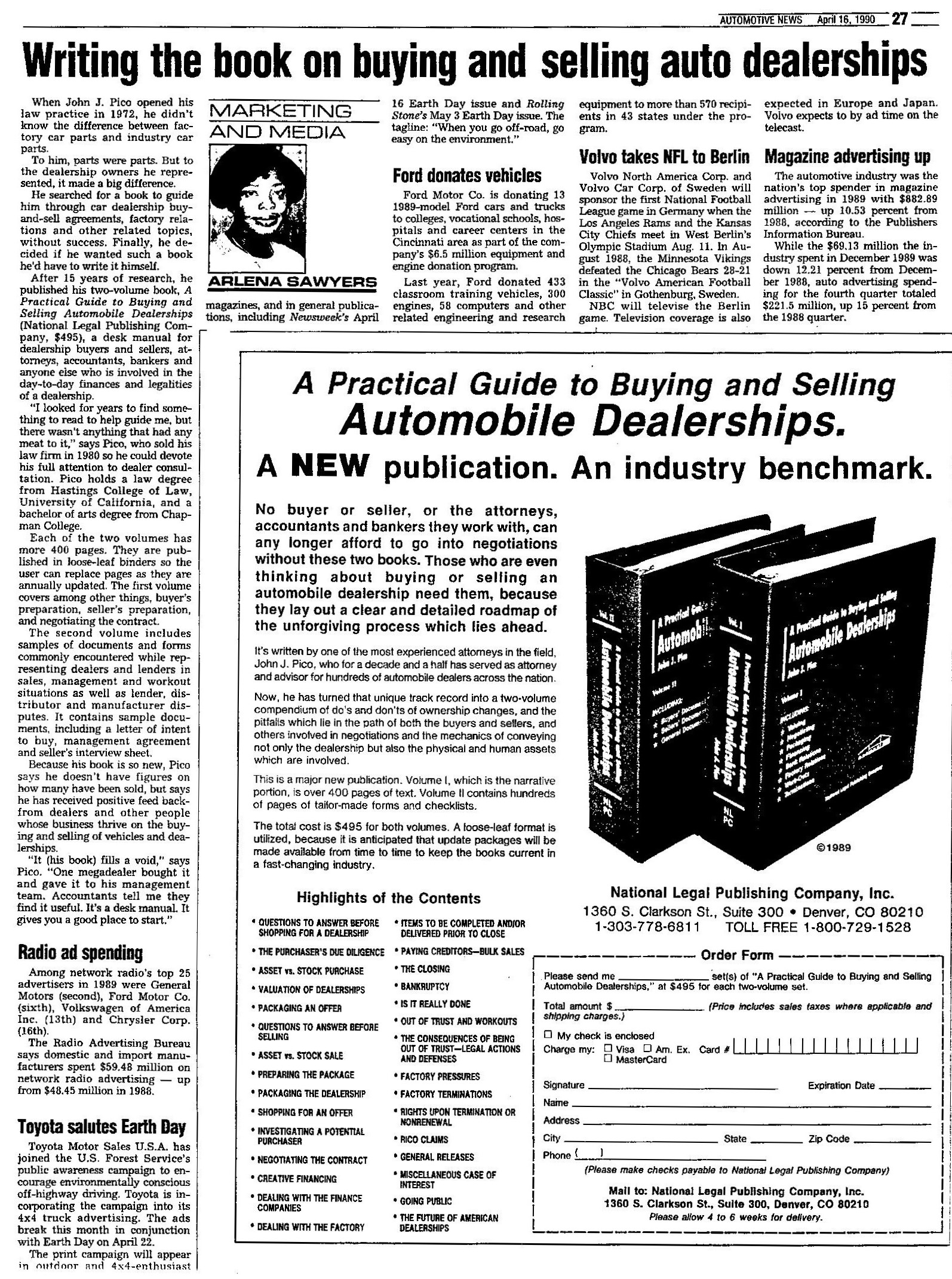
I wrote the book, published in 1989 and reviewed by Arlena Sawyer in her article, “Writing the Book on Buying and Selling Auto Dealerships,” Automotive News, April 16, 1990.
Many of the forms commonly used in dealership transactions today trace their origins to forms first published in my two-volume reference work.
THE DETAILS MAKE THE DIFFERENCE
One of the biggest problems I see with sellers today is that they have no idea what they left on the table.
They walk with a million dollars and they are happy.
They don’t realize they left $500,000 on the table. The more they make, the happier they are.
If they walk with $10 million, they don’t know and don’t care what they left on the table. If they are happy, I guess that’s OK. But a fair deal means sellers get what they deserve and the buyers pay a fair price for what they get.
Putting us on your team could definitely make the difference between the success and failure of your transaction.
Most dealers do not know the difference between “fair market value” and “fair market value continued use” or “in-place fair market value.” Or they don’t think about the “fine points” in transactions. In the case of a Chevrolet store we consulted, it was over $600,000.
Some General Motors (GM) dealers buy Mopar parts when doing warranty work. Although the parts are made by GM and eligible to be used on warranty repairs of GM vehicles, when selling a store, if the agreement describes returnable parts as ones listed in the “factory” catalogue, Mopar parts are not in the factory catalogue; they have their own catalogue.
Many dealers do not know the value of an insolvent store. When a dealer paid $10 million in blue sky for a store that went broke twice within a five-year period, most dealers thought he was crazy. Today the store is thriving and the buyer’s decision has proven wise.
WOULD YOU LIKE TO LOSE A MILLION?
People and businesses with experienced advisors generally make better decisions. That’s why we exist—to help clients avoid costly mistakes and recognize opportunities others miss.
If an investor in a car dealership makes a bad decision, the investor not only does not earn money, but usually loses money.
What hurts more: not making a million dollars, or losing a million dollars?
The same is true with buyers. Many don’t know the opportunity they missed by not paying a fair price for a dealership. Ask the buyer who paid $10 million for the bankrupt dealership.
WORDS MATTER
I often tell clients that commas can change the meaning of a contract.
Consider these two sentences:
The dealer said the factory is incompetent.
The dealer, said the factory, is incompetent.
The same words. Two commas. Two entirely different meanings.
I could not tell you the number of closings I have attended where the person on the other side of the table has looked at me and said, “I had no idea the contract said that.”
By then, it was too late. The contract said exactly what it was intended to say—that party simply hadn’t understood the legal consequences before signing it.
Every word matters. Every sentence matters. Every comma matters.
WE ARE ADVISORS–NOT BROKERS
We are not here to simply match buyers with sellers.
We are advisors who help buyers and sellers know when to hold them, when to fold them, when to walk away—and when to run.
Advising Automobile Dealers LLC
Insight that Makes a Difference


© Advising Automobile Dealers LLC